Office-to-residential lease-up marketing, Chicago
26 projects, $1.8B and 4,000+ units delivering into one downtown renter pool: the data and the lease-up playbook for Chicago conversions.
26 projects, $1.8B and 4,000+ units delivering into one downtown renter pool: the data and the lease-up playbook for Chicago conversions.
Chicago is converting offices into 4,000 homes. Someone has to fill them.
As of mid-2026, downtown Chicago has 26 office-to-residential conversion projects underway, representing roughly $1.8 billion in investment and more than 4,000 new housing units, more conversion output than the previous twenty years combined, according to industry reporting. Every one of those units has to be pre-leased or pre-sold into the same downtown market at roughly the same time. The cranes are the easy part. The absorption is the marketing problem, and it is a different marketing problem than a ground-up tower. This is the playbook, with the market data and a documented pre-sale benchmark from our own Chicago work.
The wave, by the numbers
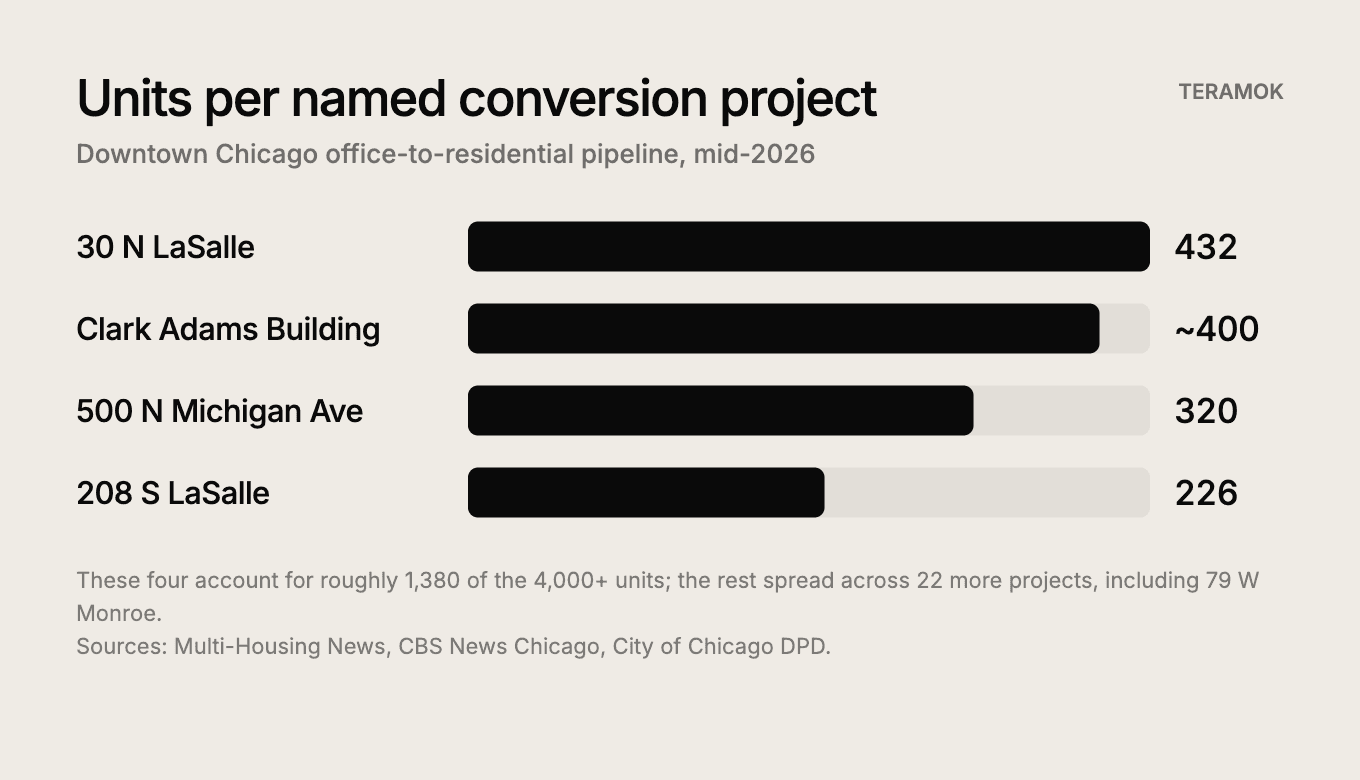
The projects reshaping the Loop and its edges, as reported by Multi-Housing News, CBS News Chicago, and the City of Chicago Department of Planning and Development:
30 N LaSalle: 432 apartments added to the Loop core, the largest named unit count in the pipeline.
Clark Adams Building: about 400 residential units downtown.
500 N Michigan Ave: a $162 million project adding 320 units near the Magnificent Mile.
208 S LaSalle: upper floors converting into 226 units with city support.
79 W Monroe: historic adaptive reuse backed by Tax Increment Financing.
Behind them sits the LaSalle Corridor revitalization program, where TIF support comes with a mandate of at least 30 percent affordable units in specific corridor developments, and zoning changes that make older high-rises easier to repurpose. Public money, public scrutiny, public timelines.
What this means for absorption
Read the chart as a leasing calendar, not a construction ledger. The four largest named projects alone put roughly 1,380 units into the Loop and the Magnificent Mile corridor, and the delivery windows cluster: TIF-backed projects run on public timelines, so several buildings will open their leasing offices into the same renter pool within months of each other. In every market where deliveries cluster, the buildings that fail to differentiate end up competing on concessions, and concessions are margin. A month of free rent across a 400-unit building is a seven-figure marketing budget spent after the fact, at the moment of least leverage.
The affordability mandate compounds this. A corridor building with 30 percent affordable units is not running one lease-up, it is running two: separate renter profiles, separate application paths, separate messages that must coexist under one property brand. And because these are public-money projects, the local press will cover them either way. The only question is whether the coverage is planned like a campaign or absorbed like weather.
Why a conversion is a different marketing problem
Five things make conversion lease-up harder than ground-up, and each one is a marketing decision, not a construction decision.
1. The building has a past life
Renters do not dream of living in an office. The first job is a perception flip: a property brand, film, and interior story strong enough that the address reads as residential from the first scroll. Buildings with history can turn that past into character, but only if someone builds the narrative deliberately.
2. Two audiences in one building
A 30 percent affordability mandate means two different renter profiles, two application paths, and two messages that must coexist without undercutting each other. Most lease-up campaigns are built for one audience; corridor conversions need a dual-track campaign from day one.
3. Public money means public attention
TIF-backed projects get covered, questioned, and watched. That is a liability if communications are reactive, and an asset if the press calendar is planned like a campaign: groundbreaking, topping out, first move-ins, corridor milestones. Earned media is free demand generation for a project the city has already made newsworthy.
4. The lease-up clock starts before the lobby exists
Pre-leasing has to begin months before delivery, when the building is still a construction site. That is a film and CGI problem: amenity previews, unit tours, and neighborhood story produced before there is anything photogenic to photograph. Waiting for the model unit is how lease-ups fall behind pro forma.
5. Everyone delivers at once
Twenty-six projects, one downtown renter pool, overlapping delivery windows. The buildings that pre-lease will be the ones that built demand early and owned their search results, their neighborhood queries, and their AI-answer presence before the competing lobbies opened.
The benchmark: what pre-delivery demand looks like when it works
This is not theory. On a 48-unit residential development in Chicago's West Loop, TERAMOK ran a 7-month pre-construction campaign that reserved 22 of the 48 units, 46 percent of the building, before construction was visible on site. The developer's name is under NDA and we say that plainly rather than invent a substitute; every number is documented in Google Analytics, Search Console, and Meta reporting, and we walk through the dashboards on intro calls. The full breakdown is published as a pre-construction case study.
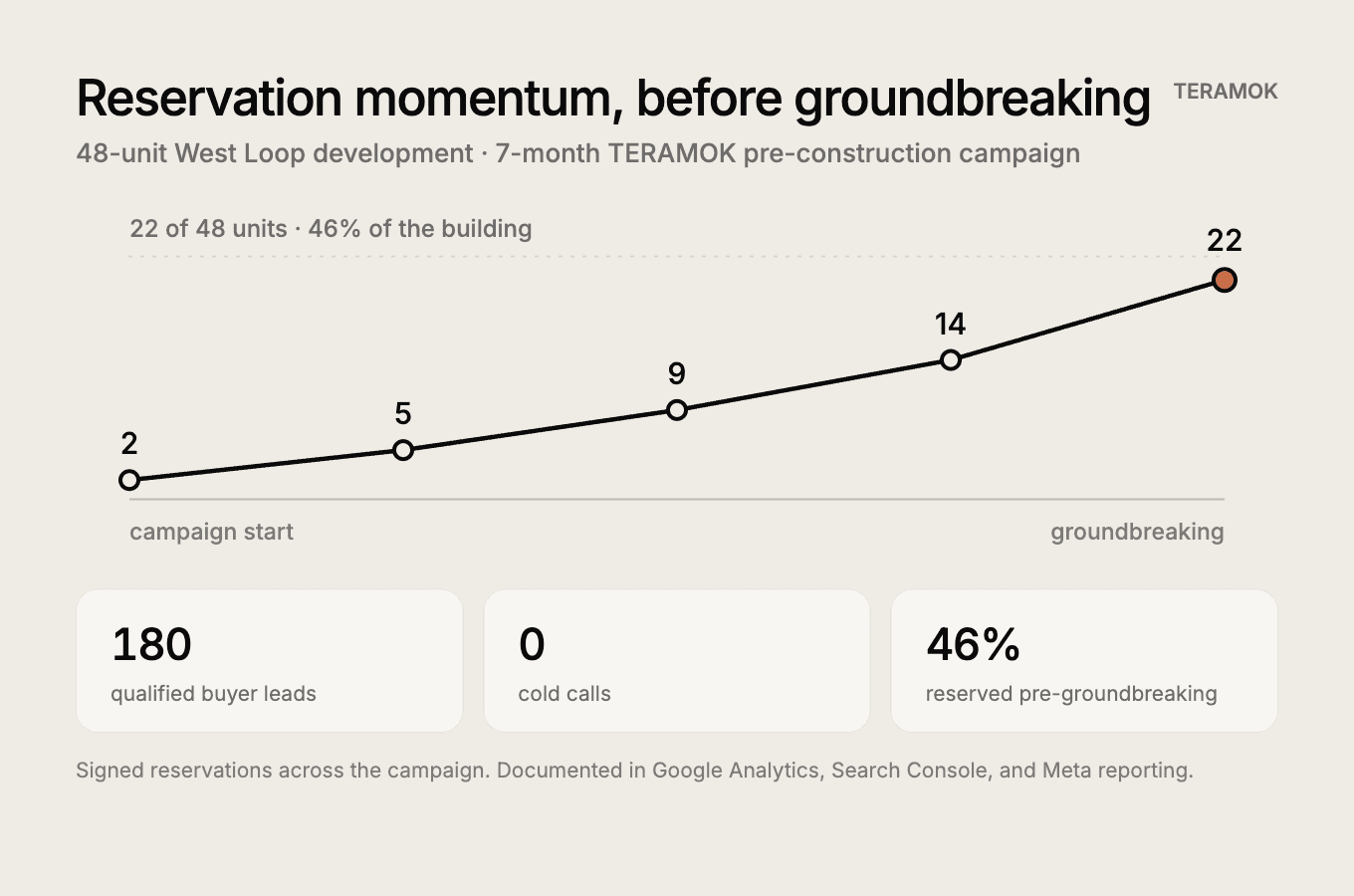
Three things in that curve matter for a conversion project:
It compounds instead of spiking. Reservations ran 2, then 5, then 9, then 14, then 22. That shape is what a system produces: positioning first, then a conversion-built landing experience, then production, then paid deployment, each act feeding the next. A launch stunt produces the opposite shape, a spike that dies.
Zero cold calls. Every one of the 22 reservations began as inbound interest generated by the campaign. For a lease-up team, that is the difference between closing and prospecting.
The demand was built when there was nothing to photograph. Renders treated as a film subject, the neighborhood shot as proof of place. That is exactly the situation every conversion project is in during the pre-leasing window.
That campaign was a for-sale presale; a conversion is mostly a lease-up. The product differs, the physics do not: demand is built before delivery or paid for after it, in concessions.
The lease-up system, mapped to a conversion
Positioning and property brand: the past-life flip, named and designed. See brand building.
Cinema-grade film early: amenity and unit previews shot and rendered before delivery, on our own RED and ARRI equipment. See production.
A lease-up website with live inventory: floor plans, pricing bands, tour booking, dual-track affordable and market-rate paths. See launch websites.
Paid media by commute shed: Google, Meta, and YouTube targeted to the renter profiles the building actually serves, measured in signed leases per week against pro forma. See Chicago multifamily marketing.
A press calendar tied to the TIF milestones: the public story managed as an asset. See real estate PR.
Model it interactively: the free lease-up budget calculator runs this exact model on your building: scheduled rents, cost of delay, and the leases-per-week target, using the published rate sheet.
If you are running one of these projects
TERAMOK is a strategy-first marketing agency headquartered in Chicago, working with developers, architecture firms, and contractors. Pricing is published at teramok.us/pricing, presale and lease-up systems are scoped before contracts are signed, and everything from film to paid media runs in-house. If your conversion delivers in 2026 or 2027, the pre-leasing window is already open. Book a strategy call.
Written by Kirill Samarits, Founder and CEO of TERAMOK. Market figures are drawn from mid-2026 reporting by Multi-Housing News, CBS News Chicago, and the City of Chicago Department of Planning and Development; project details change, verify current status with the city before underwriting decisions.
Related TERAMOK services
Chicago is converting offices into 4,000 homes. Someone has to fill them.
As of mid-2026, downtown Chicago has 26 office-to-residential conversion projects underway, representing roughly $1.8 billion in investment and more than 4,000 new housing units, more conversion output than the previous twenty years combined, according to industry reporting. Every one of those units has to be pre-leased or pre-sold into the same downtown market at roughly the same time. The cranes are the easy part. The absorption is the marketing problem, and it is a different marketing problem than a ground-up tower. This is the playbook, with the market data and a documented pre-sale benchmark from our own Chicago work.
The wave, by the numbers
The projects reshaping the Loop and its edges, as reported by Multi-Housing News, CBS News Chicago, and the City of Chicago Department of Planning and Development:
30 N LaSalle: 432 apartments added to the Loop core, the largest named unit count in the pipeline.
Clark Adams Building: about 400 residential units downtown.
500 N Michigan Ave: a $162 million project adding 320 units near the Magnificent Mile.
208 S LaSalle: upper floors converting into 226 units with city support.
79 W Monroe: historic adaptive reuse backed by Tax Increment Financing.
Behind them sits the LaSalle Corridor revitalization program, where TIF support comes with a mandate of at least 30 percent affordable units in specific corridor developments, and zoning changes that make older high-rises easier to repurpose. Public money, public scrutiny, public timelines.
What this means for absorption
Read the chart as a leasing calendar, not a construction ledger. The four largest named projects alone put roughly 1,380 units into the Loop and the Magnificent Mile corridor, and the delivery windows cluster: TIF-backed projects run on public timelines, so several buildings will open their leasing offices into the same renter pool within months of each other. In every market where deliveries cluster, the buildings that fail to differentiate end up competing on concessions, and concessions are margin. A month of free rent across a 400-unit building is a seven-figure marketing budget spent after the fact, at the moment of least leverage.
The affordability mandate compounds this. A corridor building with 30 percent affordable units is not running one lease-up, it is running two: separate renter profiles, separate application paths, separate messages that must coexist under one property brand. And because these are public-money projects, the local press will cover them either way. The only question is whether the coverage is planned like a campaign or absorbed like weather.
Why a conversion is a different marketing problem
Five things make conversion lease-up harder than ground-up, and each one is a marketing decision, not a construction decision.
1. The building has a past life
Renters do not dream of living in an office. The first job is a perception flip: a property brand, film, and interior story strong enough that the address reads as residential from the first scroll. Buildings with history can turn that past into character, but only if someone builds the narrative deliberately.
2. Two audiences in one building
A 30 percent affordability mandate means two different renter profiles, two application paths, and two messages that must coexist without undercutting each other. Most lease-up campaigns are built for one audience; corridor conversions need a dual-track campaign from day one.
3. Public money means public attention
TIF-backed projects get covered, questioned, and watched. That is a liability if communications are reactive, and an asset if the press calendar is planned like a campaign: groundbreaking, topping out, first move-ins, corridor milestones. Earned media is free demand generation for a project the city has already made newsworthy.
4. The lease-up clock starts before the lobby exists
Pre-leasing has to begin months before delivery, when the building is still a construction site. That is a film and CGI problem: amenity previews, unit tours, and neighborhood story produced before there is anything photogenic to photograph. Waiting for the model unit is how lease-ups fall behind pro forma.
5. Everyone delivers at once
Twenty-six projects, one downtown renter pool, overlapping delivery windows. The buildings that pre-lease will be the ones that built demand early and owned their search results, their neighborhood queries, and their AI-answer presence before the competing lobbies opened.
The benchmark: what pre-delivery demand looks like when it works
This is not theory. On a 48-unit residential development in Chicago's West Loop, TERAMOK ran a 7-month pre-construction campaign that reserved 22 of the 48 units, 46 percent of the building, before construction was visible on site. The developer's name is under NDA and we say that plainly rather than invent a substitute; every number is documented in Google Analytics, Search Console, and Meta reporting, and we walk through the dashboards on intro calls. The full breakdown is published as a pre-construction case study.
Three things in that curve matter for a conversion project:
It compounds instead of spiking. Reservations ran 2, then 5, then 9, then 14, then 22. That shape is what a system produces: positioning first, then a conversion-built landing experience, then production, then paid deployment, each act feeding the next. A launch stunt produces the opposite shape, a spike that dies.
Zero cold calls. Every one of the 22 reservations began as inbound interest generated by the campaign. For a lease-up team, that is the difference between closing and prospecting.
The demand was built when there was nothing to photograph. Renders treated as a film subject, the neighborhood shot as proof of place. That is exactly the situation every conversion project is in during the pre-leasing window.
That campaign was a for-sale presale; a conversion is mostly a lease-up. The product differs, the physics do not: demand is built before delivery or paid for after it, in concessions.
The lease-up system, mapped to a conversion
Positioning and property brand: the past-life flip, named and designed. See brand building.
Cinema-grade film early: amenity and unit previews shot and rendered before delivery, on our own RED and ARRI equipment. See production.
A lease-up website with live inventory: floor plans, pricing bands, tour booking, dual-track affordable and market-rate paths. See launch websites.
Paid media by commute shed: Google, Meta, and YouTube targeted to the renter profiles the building actually serves, measured in signed leases per week against pro forma. See Chicago multifamily marketing.
A press calendar tied to the TIF milestones: the public story managed as an asset. See real estate PR.
Model it interactively: the free lease-up budget calculator runs this exact model on your building: scheduled rents, cost of delay, and the leases-per-week target, using the published rate sheet.
If you are running one of these projects
TERAMOK is a strategy-first marketing agency headquartered in Chicago, working with developers, architecture firms, and contractors. Pricing is published at teramok.us/pricing, presale and lease-up systems are scoped before contracts are signed, and everything from film to paid media runs in-house. If your conversion delivers in 2026 or 2027, the pre-leasing window is already open. Book a strategy call.
Written by Kirill Samarits, Founder and CEO of TERAMOK. Market figures are drawn from mid-2026 reporting by Multi-Housing News, CBS News Chicago, and the City of Chicago Department of Planning and Development; project details change, verify current status with the city before underwriting decisions.
Related TERAMOK services
Editorial standards
Written by TERAMOK’s strategy team from direct work with real estate developers, architecture firms, construction companies, and operators. Claims are tied to published project evidence or identified as general guidance.

Get started
Chicago's in-house production and marketing team for real estate.
Book a free 30-minute strategy call. Tell us about your project, your firm, or your launch — and we'll show you exactly how TERAMOK plugs into your operation with cinema-grade production, campaign strategy, and senior creative.
Get started
Chicago's in-house production and marketing team for real estate.
Book a free 30-minute strategy call. Tell us about your project, your firm, or your launch — and we'll show you exactly how TERAMOK plugs into your operation with cinema-grade production, campaign strategy, and senior creative.
Get started
Chicago's in-house production and marketing team for real estate.
Book a free 30-minute strategy call. Tell us about your project, your firm, or your launch — and we'll show you exactly how TERAMOK plugs into your operation with cinema-grade production, campaign strategy, and senior creative.